spinner
Frische Löwenzahnwiese mit dem Vierwaldstättersee im Hintergrund.

Lake Lucerne

The Heart of Central Switzerland

Fjord-like bays, striking peaks and historic lakeside villages shape Lake Lucerne. Between Lucerne, Rigi, Pilatus and the Urnersee, a landscape unfolds that is surprising, diverse, powerful and unique in Switzerland. Those travelling here experience nature, history and panorama in one perfect round trip.
Lake Lucerne

The Lake in Numbers

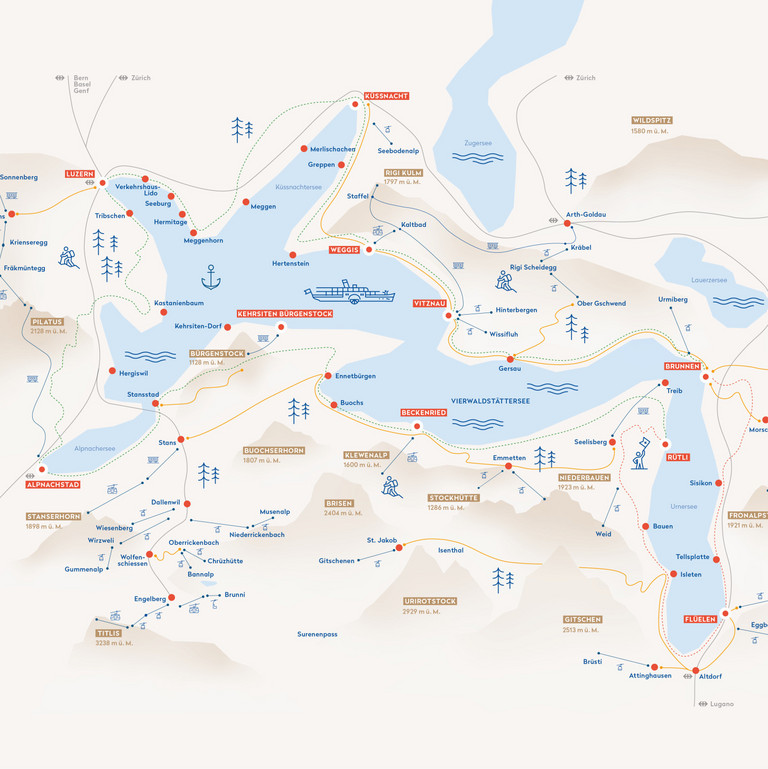
Lake Lucerne is one of the most impressive lakes in Switzerland – not only because of its size, but above all because of its shape and location.

  • Surface area: 114 km²
  • Shoreline length: 130 km
  • Water renewal time: 3.4 years
  • Average depth: 117 m
  • Maximum depth: 214 m (Gersau Basin)
  • Altitude: 433 m above sea level
  • Trophic state: Nutrient-poor (oligotrophic)
  • Currently 31 boat stations
     

Click here for the map

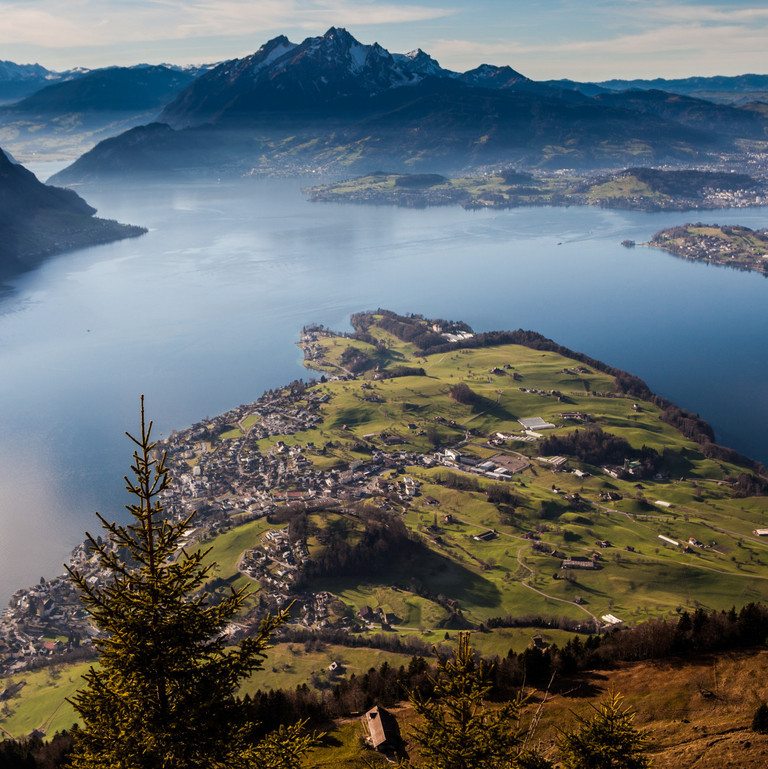
Man hat einen Ausblick auf Weggis und auf den Vierwaldstättersee mit Bergen.
How the Lake Breathes

A Lake in Natural Balance

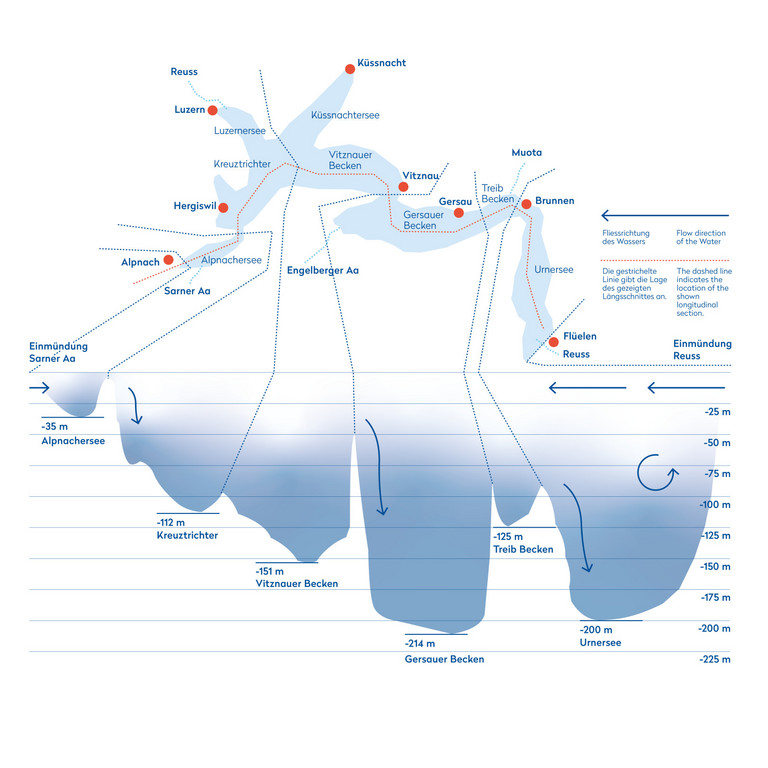
Lake Lucerne is naturally nutrient-poor. The reason lies in the structure and use of its catchment area, its particular shape, and its shoreline and depth conditions. For most of the year, the lake is stratified: lighter, warmer water floats on the surface above heavier, colder deep water. In winter, when water temperatures reach around 4°C, the lake mixes completely, as wind sets the water in motion. This process supplies the deep water and lakebed with oxygen again.
Dynamics in the Depths

A Special Feature: Underwater Waterfalls

Due to the foehn wind and the inflow of the River Reuss, the deep areas of the Urnersee are better ventilated and warmer than those of the Gersau Basin. This temperature difference drives huge underwater waterfalls from the Gersau Basin into the Urner Basin. Similar deep-water currents also flow from Lake Alpnach via the Kreuztrichter and the Vitznau Basin into the Gersau Basin. There, the water flows close to the bottom in the opposite direction of the surface current.
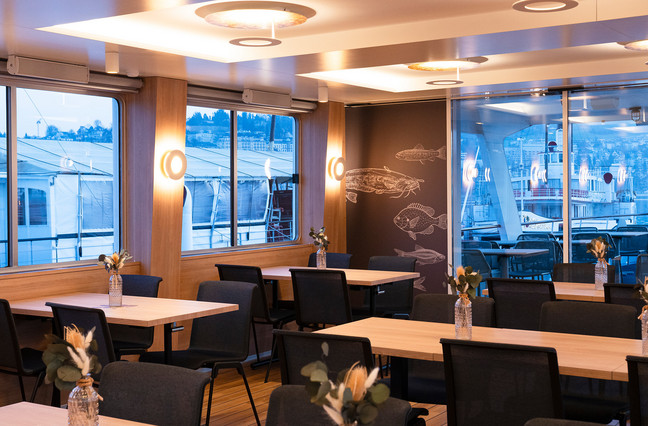
About the graphic

Fish world of Lake Lucerne

Native fish species as a design element

Native fish species as a design element

The interior also reveals a surprising perspective on the underwater world of Lake Lucerne – find out more here.

Did you know…

The name goes back to the historic forest cantons of Unterwalden, Schwyz, Uri and Lucerne, which surround the lake and continue to shape its history to this day.

In 1601, following an earthquake, tsunamis occurred on Lake Lucerne, with waves believed to have reached heights of up to 4 metres. Another such event is said to have taken place in 1687.

In the past, Lake Lucerne was a key transport axis, and until 1863 it was even the only trade connection to the Gotthard Pass.

Because of its shape, the Jacobiweiher in the Frankfurt city forest is colloquially known as Lake Lucerne. For the same reason, an artificial lake in Berlin Zoo is also referred to as Lake Lucerne.

Around 12,000 years ago, the lake was formed as a glacial margin lake at the end of the Ice Age. Melting glaciers shaped the fjord-like landscape that makes Lake Lucerne so unique to this day.
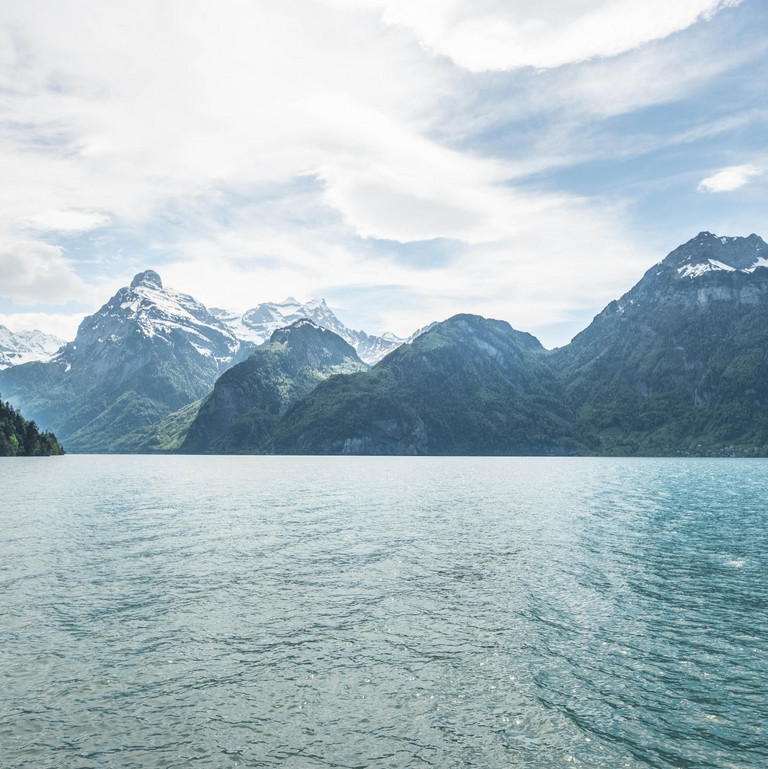
Mountain landscape Lake Lucerne
Waterways of Lake Lucerne

Inflow, Delta and Outflow of the Reuss

The Reuss near Flüelen and Seedorf, the Sarner Aa near Alpnachstad, the Engelberger Aa near Buochs and the Muota near Brunnen are among the most important inflows to Lake Lucerne. The Reuss in particular, which descends with a steep gradient from the Gotthard massif, carries large quantities of sediment. As a result, the Reuss delta has advanced around ten kilometres northwards into the Urnersee over time.

There is also a single outflow: the Reuss. It leaves Lake Lucerne in Lucerne – regulated by a weir.

Highlights along your cruise

Discover the most beautiful sights from the water

A cruise on Lake Lucerne is more than just a journey from A to B. Along the shores, impressive natural scenery, historic sites and iconic landmarks await you – seen from a perspective that only the ship can offer.
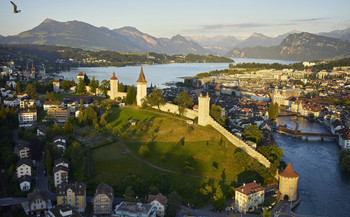
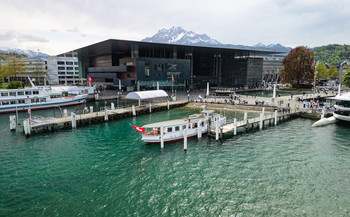
Lucerne Bay

Musegg Wall
 
Musegg Wall
Route Highlights

With its nine towers, the Musegg Wall forms part of the historic fortifications of the city of Lucerne. Apart from a section of around 40 metres, the fortification has remained almost completely intact to this day and stretches over a length of 870 metres. Several of the towers are open to the public and offer unique views of the city.

 
KKL Lucerne
 
KKL Lucerne
Route Highlights

The Culture and Convention Centre Lucerne (KKL) is centrally located in Lucerne, directly on the shores of Lake Lucerne, and was designed by architect Jean Nouvel. It is considered one of Switzerland’s most important cultural venues and is renowned for its concert hall with outstanding acoustics. The KKL serves as a venue for concerts, conventions, and cultural events.

 
Tribschen
 
Tribschen
Route Highlights

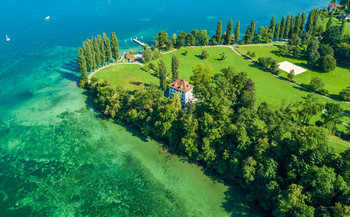
Tribschen is a small peninsula on Lake Lucerne in the city of Lucerne, home to a school, a lido, sports facilities, and the Richard Wagner Museum. The historic country estate once served as the residence of composer Richard Wagner. Today, the area invites visitors to relax and explore, thanks to its green spaces and lakeside setting.

 
Swiss Museum of Transport
 
Swiss Museum of Transport
Route Highlights

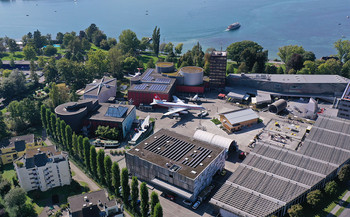
The Swiss Museum of Transport is Switzerland’s most visited museum and is located in Lucerne, directly on the shores of Lake Lucerne. It showcases significant developments in the history of mobility through a wide range of vehicles, technology exhibits, and interactive displays. The museum experience is further enhanced by a planetarium and additional attractions, offering visitors a varied and engaging experience.


Route Highlights

Lake Küssnacht

Route Highlights

Lake Uri

Weggis Basin and Stans Funnel

Rigi
 
Rigi
Route Highlights

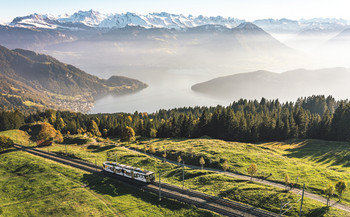
The Rigi is a prominent mountain massif situated between Lake Lucerne, Lake Zug, and Lake Lauerz in Central Switzerland. Known as the “Queen of the Mountains”, it offers numerous viewpoints with spectacular panoramic views. The area is easily accessible by various mountain railways and Lake Lucerne Navigation Company (SGV) services, making the Rigi a popular excursion destination.

 
Hammetschwand Lift
 
Hammetschwand Lift
Route Highlights

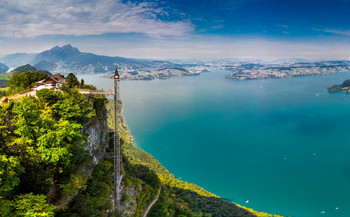
At an elevation of 1,132 metres, the Hammetschwand Lift is Europe’s highest outdoor elevator. It connects the Bürgenstock with the Hammetschwand viewpoint, offering spectacular views over Lake Lucerne and the surrounding mountains. This historic lift operates under a federal concession for commercial passenger transport and is considered an important cultural landmark of the region.

 
Bürgenstock
 
Bürgenstock
Route Highlights

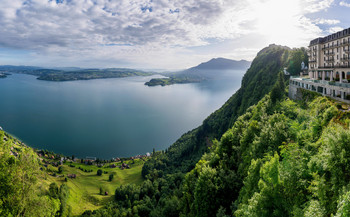
The Bürgenstock is a 1,128-metre-high mountain in the Lucerne Pre-Alps, overlooking Lake Lucerne in the canton of Nidwalden. It is renowned for its impressive views of the lake, the Hammetschwand Lift, and the Bürgenstock Resort, and is considered one of the region’s most popular excursion destinations.

 
Fortress Fürigen
 
Fortress Fürigen
Route Highlights

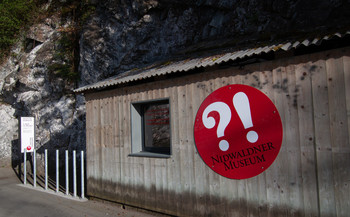
Fortress Fürigen is located in Stansstad, in the canton of Nidwalden, on the slopes of the Bürgenstock at an altitude of 435 metres above sea level. Concealed behind artificially designed rock faces along the lakeside road, the former military installation formed part of the Swiss National Redoubt during the Second World War. Today, the fortress is open to visitors as a museum.


Beckenried

Klewenalp
 
Klewenalp
Route Highlights

Klewenalp is a mountain plateau situated at 1,593 metres above sea level south of Lake Lucerne in the canton of Nidwalden. It is a popular ski area in winter and a versatile destination for hikers and outdoor enthusiasts during the summer months. Klewenalp can be conveniently reached by cable car from Beckenried or via a network of hiking trails.

 
Risleten Gorge
 
Risleten Gorge
Route Highlights

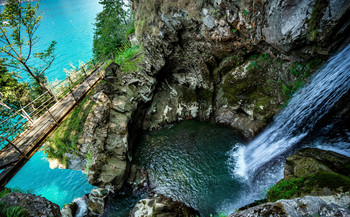
The Risleten Gorge is an impressive natural gorge near Beckenried on Lake Lucerne. Along the lakeside trail, hikers pass through a rugged landscape of steep rock faces, small waterfalls, and dense woodland. Relatively unknown to many visitors, the gorge is considered a peaceful hidden gem for hikers and nature lovers.


Lake Alpnach

Pilatus & Pilatus Railway
 
Pilatus & Pilatus Railway
Route Highlights

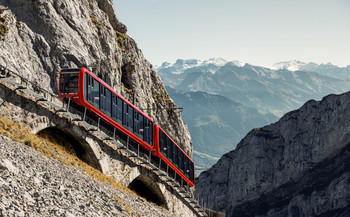
Mount Pilatus is a striking mountain massif south of Lucerne and one of the most popular excursion destinations around Lake Lucerne. From Alpnachstad, the Pilatus Railway – the world’s steepest cogwheel railway – ascends to the famous mountain. Over a distance of 4,618 metres, it conquers gradients of up to 48%, offering spectacular views of Lake Lucerne and the surrounding Alpine landscape throughout the journey.

 
Acheregg Bridge
 
Acheregg Bridge
Route Highlights

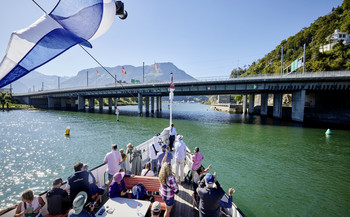
The Acheregg Bridge is a motorway bridge connecting Stansstad and Hergiswil and marking the transition between Lake Lucerne and Lake Alpnach. A unique feature can be observed when the steamboat Unterwalden passes beneath the bridge: its funnel can be lowered, allowing the vessel to clear the bridge and continue its journey onto Lake Alpnach.

 
Stanserhorn
 
Stanserhorn
Route Highlights

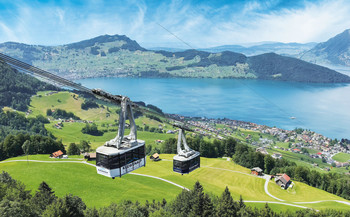
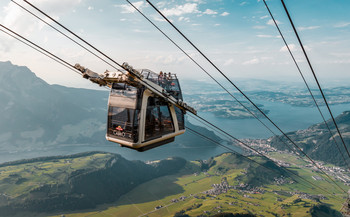
The Stanserhorn is a mountain rising to 1,897 metres above sea level, located south of Lake Lucerne. It is renowned for the CabriO double-decker cable car, which offers a unique travel experience with an open-air upper deck. At the summit, a revolving restaurant invites visitors to relax while enjoying spectacular views of Lake Lucerne and the surrounding mountain landscape.


Horwer Bay

Glasi Hergisiwl
 
Glasi Hergisiwl
Route Highlights

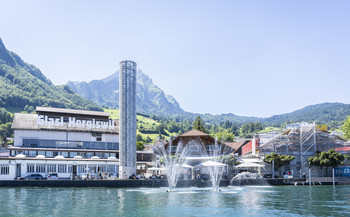
Glasi Hergiswil is a traditional glassworks located on the shores of Lake Lucerne and the last glass factory of its kind in Switzerland. Glass is still produced here today using elaborate handcrafted techniques. The glassworks is renowned for its highquality, handmade products. Visitors can watch the glassmakers at work, explore the history of glass in the museum, and enjoy time in the Glasi Park.

 
Youtube

We need your consent to be able to load the video.
We have integrated YouTube to display videos. This service may collect data about your activities. Further information can be found in our privacy policy.

Accept
More information